Calculate and extract remote sensing metrics for spatial health analysis 🛰️. This package offers R users a quick and easy way to obtain areal or zonal statistics of key indicators and covariates, ideal for modeling infectious diseases 🦠 within the framework of spatial epidemiology 🏥.
1. Installation
You can install the development version with:
# install.packages("pak")
pak::pak("harmonize-tools/land4health")
or also the official version available on CRAN:
install.packages("land4health")
library(land4health)
# l4h_install()
#> ── rgee 1.1.8 ──────────────────────────────────────── earthengine-api 1.7.38 ──
#> ✔ user: geografo.pe@gmail.com
#> ✔ Initializing Google Earth Engine: ✔ Initializing Google Earth Engine: DONE!
#> ✔ Earth Engine account: projects/424340891660/assets/Rio_navegables
#> ✔ Python Path: C:/Python314/python.exe
#> ────────────────────────────────────────────────────────────────────────────────2. List of available metrics
l4h_list_metrics()
#> # A tibble: 10 × 11
#> category metric pixel_resolution_met…¹ dataset start_year end_year
#> <chr> <chr> <chr> <chr> <int> <int>
#> 1 Human intervention Defore… 30 Hansen… 2000 2023
#> 2 Human intervention Human … 300 Global… 1990 2017
#> 3 Human intervention Popula… 100 WorldP… 2000 2021
#> 4 Human intervention Urban … 500 MODIS … 2001 2022
#> 5 Human intervention Night … 500 VIIRS … 1992 2023
#> 6 Human intervention Human … 30 Global… 1975 2030
#> 7 Environment Urban … 1000 Urban … 2003 2020
#> 8 Accessibility Travel… 927.67 Malari… 2019 2020
#> 9 Accessibility Rural … 100 Rural … 2024 2024
#> 10 Climate Evapot… 500 geeSEB… 2002 2022
#> # ℹ abbreviated name: ¹pixel_resolution_meters
#> # ℹ 5 more variables: resolution_temporal <chr>, layer_can_be_actived <lgl>,
#> # tags <chr>, lifecycle <chr>, url <chr>
#> ... (3 more)3. Example: Calculate Forest Loss in a Custom Region
This example demonstrates how to calculate forest loss between 2005 and 2020 using a custom polygon and Earth Engine.
# install.packages('geoidep')
library(geoidep)

# Downloading the adminstration limits of Loreto provinces
provinces_loreto <- get_provinces(show_progress = FALSE) |>
  subset(nombdep == "LORETO")

# Run forest loss calculation
result <- provinces_loreto |>
  l4h_forest_loss(from = '2011-01-01', to = '2025-01-01', sf = TRUE)

head(result)
#> Simple feature collection with 6 features and 8 fields
#> Geometry type: MULTIPOLYGON
#> Dimension:     XY
#> Bounding box:  xmin: -75.78115 ymin: -4.709709 xmax: -72.11719 ymax: -0.63937
#> Geodetic CRS:  WGS 84
#> # A tibble: 6 × 9
#>   ccdd  ccpp  fuente                  nombdep nombprov date       variable value
#>   <chr> <chr> <chr>                   <chr>   <chr>    <date>     <chr>    <dbl>
#> 1 16    01    V Censo Nacional Econo… LORETO  MAYNAS   2011-01-01 forest_…  38.3
#> 2 16    01    V Censo Nacional Econo… LORETO  MAYNAS   2012-01-01 forest_…  73.9
#> 3 16    01    V Censo Nacional Econo… LORETO  MAYNAS   2013-01-01 forest_…  60.5
#> 4 16    01    V Censo Nacional Econo… LORETO  MAYNAS   2014-01-01 forest_…  76.7
#> 5 16    01    V Censo Nacional Econo… LORETO  MAYNAS   2015-01-01 forest_…  81.9
#> 6 16    01    V Censo Nacional Econo… LORETO  MAYNAS   2016-01-01 forest_…  59.0
#> # ℹ 1 more variable: geometry <MULTIPOLYGON [°]>
# Visualization with ggplot2
library(ggplot2)
library(dplyr)
# Mean by departamentos
df_mean <- result |>
  st_drop_geometry() |>
  group_by(date) |>
  summarise(mean_val = mean(value, na.rm = TRUE))

ggplot() +
  geom_line(
    data = df_mean,
    aes(x = date, y = mean_val, color = "Dept Mean"),
    linetype = "dashed",
    linewidth = 0.8
    ) +
  geom_line(
    data = st_drop_geometry(result),
    aes(x = date, y = value, color = "Province"),
    linewidth = 1
    ) +
  facet_wrap(~ nombprov) +
  scale_color_manual(values = c("Dept Mean" = "#B2182B", "Province" = "#2166AC")) +
  labs(
    title = "Forest Loss: Province vs. Department Mean",
    subtitle = "Comparison of local values against regional average",
    x = "Date",
    y = "Value",
    color = "Legend"
  ) +
  theme_minimal() +
  theme(legend.position = "bottom")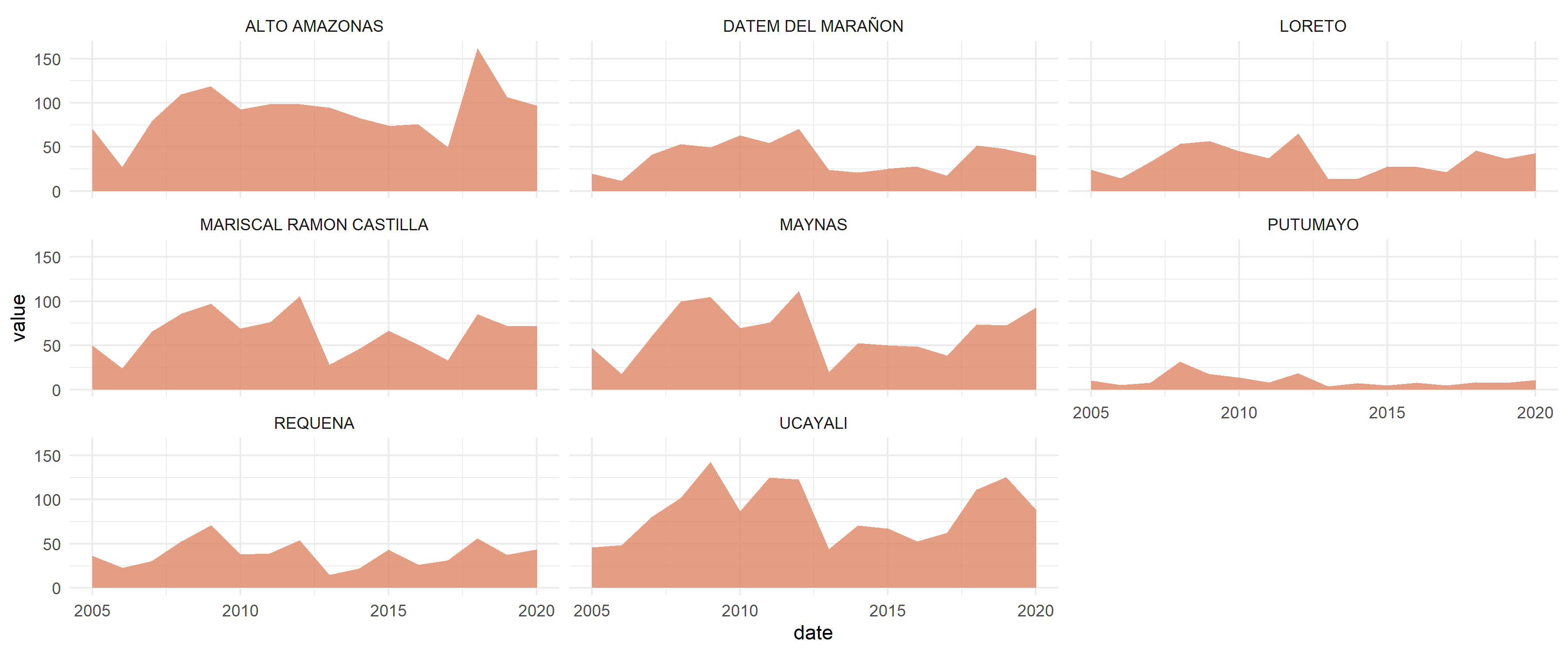
result_clean <- result |>
  mutate(
    year = format(as.Date(date), "%Y"),
    nombprov = toupper(trimws(as.character(nombprov)))
  )

q_vals <- quantile(
  result_clean$value,
  probs = c(0, 0.05, 0.25, 0.75, 0.95, 1),
  na.rm = TRUE
  )

q_labs <- c(
  paste0("< ", round(q_vals[2], 1)),
  paste0(round(q_vals[2:4], 1), " – ", round(q_vals[3:5], 1)),
  paste0("> ", round(q_vals[5], 1))
  )

pal <- c("#2166AC", "#67A9CF", "#F7F7F7", "#F4A582", "#B2182B")

result_clean %>%
  mutate(
    loss_cat = cut(
      value,
      breaks = q_vals,
      labels = q_labs,
      include.lowest = TRUE
      )
    ) %>%
  ggplot() +
  geom_sf(aes(fill = loss_cat), color = "#000000", linewidth = 0.15) +
  scale_fill_manual(
    name = "Forest Loss (km²)",
    values = setNames(pal,q_labs)
  ) +
  facet_wrap(~ year, ncol = 5) +
  labs(
    title = "Spatiotemporal Evolution of Tree Cover Loss by Province",
    subtitle = "Loreto, Peru (2011–2025)"
  ) +
  theme_minimal(base_size = 10)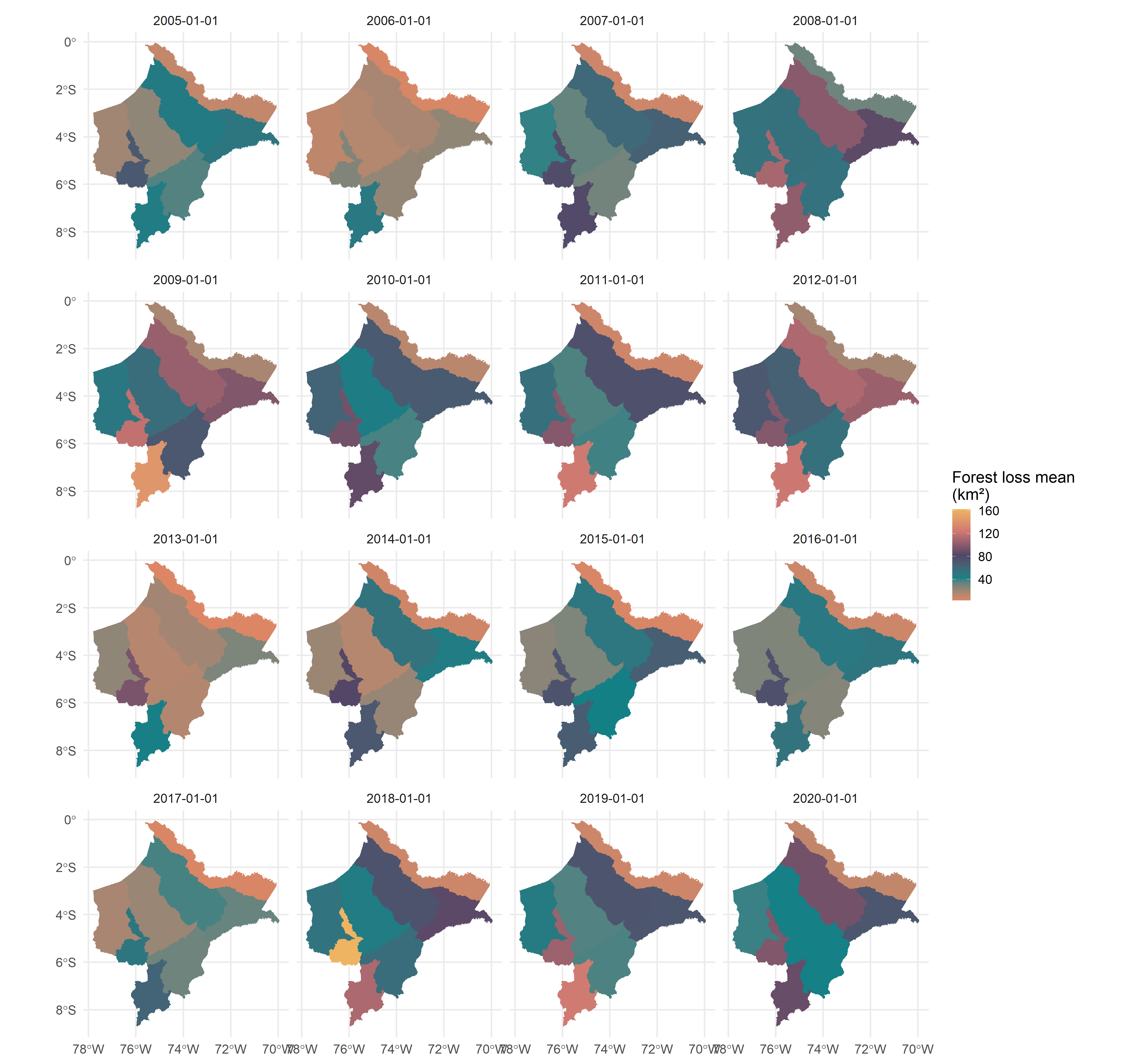
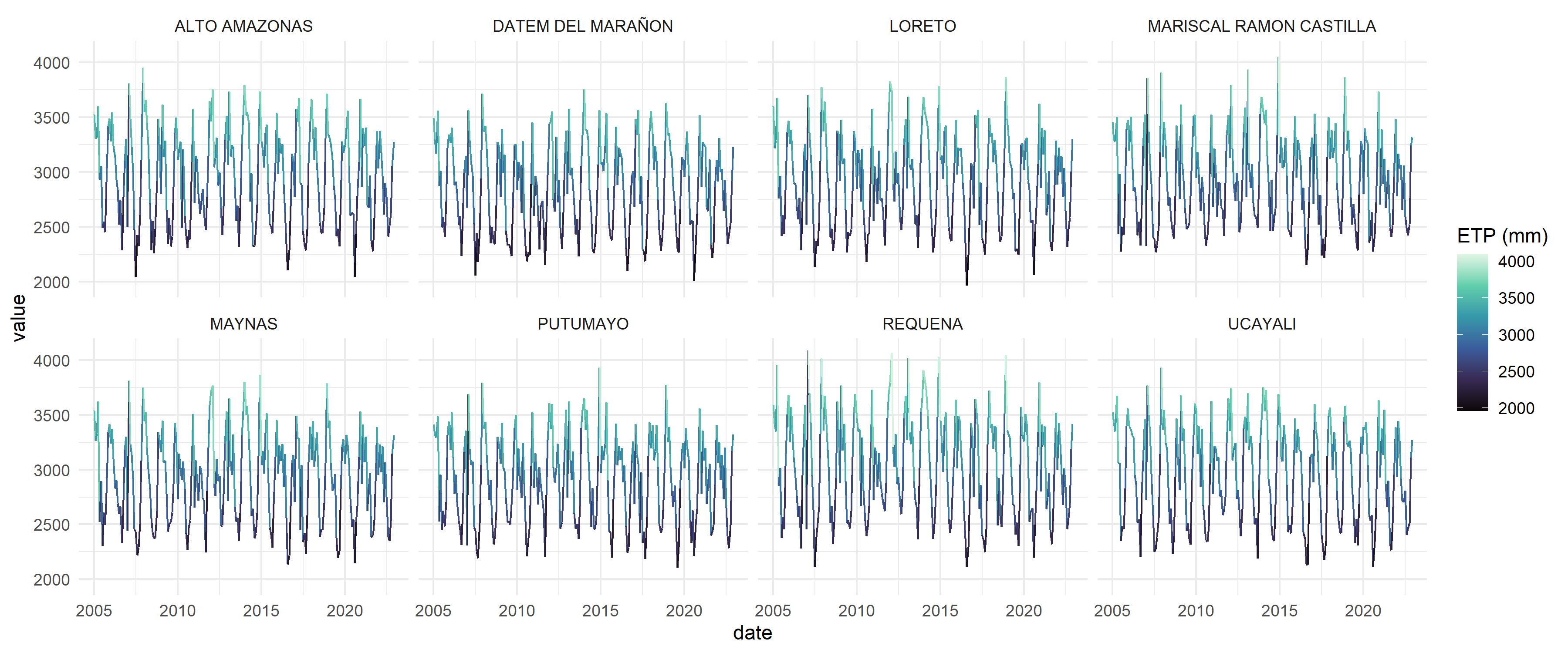
4. Example: Extract time series of climate variables
etp_ts <- provinces_loreto |>
  l4h_sebal_modis(
    from = "2005-01-01",
    to = "2022-12-31",
    by = "month"
  )
etp_base <- etp_ts |>
  st_drop_geometry() |>
  mutate(
    nombprov = toupper(trimws(as.character(nombprov))),
    month = as.numeric(format(as.Date(date), "%m"))
  )

etp_loreto <- etp_base |>
  group_by(month) |>
  summarise(mean_loreto = mean(value, na.rm = TRUE), .groups = "drop")

etp_diff <- etp_base |>
  group_by(nombprov, month) |>
  summarise(mean_prov = mean(value, na.rm = TRUE), .groups = "drop") |>
  inner_join(etp_loreto, by = "month") |>
  mutate(
    ymax_pos = pmax(mean_prov, mean_loreto),
    ymin_neg = pmin(mean_prov, mean_loreto)
  )
head(etp_diff)
#> # A tibble: 6 × 6
#>   nombprov      month mean_prov mean_loreto ymax_pos ymin_neg
#>   <chr>         <dbl>     <dbl>       <dbl>    <dbl>    <dbl>
#> 1 ALTO AMAZONAS     1     3165.       3106.    3165.    3106.
#> 2 ALTO AMAZONAS     2     3459.       3430.    3459.    3430.
#> 3 ALTO AMAZONAS     3     3264.       3192.    3264.    3192.
#> 4 ALTO AMAZONAS     4     3214.       3128.    3214.    3128.
#> 5 ALTO AMAZONAS     5     2912.       2915.    2915.    2912.
#> 6 ALTO AMAZONAS     6     2736.       2751.    2751.    2736.
ggplot(etp_diff, aes(x = month)) +
  geom_ribbon(
    aes(ymin = mean_loreto, ymax = ymax_pos, fill = "Above Average"),
    alpha = 0.6
  ) +
  geom_ribbon(
    aes(ymin = ymin_neg, ymax = mean_loreto, fill = "Below Average"),
    alpha = 0.6
  ) +
  geom_line(
    aes(y = mean_loreto),
    color = "#475569",
    linetype = "dashed",
    linewidth = 0.7
  ) +
  geom_line(
    aes(y = mean_prov),
    color = "#0F172A",
    linewidth = 0.8
  ) +
  facet_wrap(~ nombprov, ncol = 4) +
  scale_fill_manual(
    name = "Regional Deviation",
    values = c(
      "Above Average" = "#EF4444",
      "Below Average" = "#3B82F6"
    )
  ) +
  scale_x_continuous(
    breaks = c(1, 4, 7, 10),
    labels = c("Jan", "Apr", "Jul", "Oct")
  ) +
  labs(
    title = "Provincial ETP Differential vs. Regional Average",
    subtitle = "Dashed line: Loreto Average | Red: ETP Excess | Blue: ETP Deficit",
    x = NULL,
    y = "Average ETP (mm)"
  ) +
  theme_minimal(base_size = 8) +
  theme(legend.position = "bottom")